You are reading a real estate ad that mentions an F2, then another that talks about a T2. The housing seems identical, but the letters change. This confusion hinders many searches, while the classification system for apartments is based on a simple logic: the number of living rooms.
Main room and living area: what the number after the letter really measures
The number that follows the letter F (or T) corresponds to the number of main rooms in the apartment. A main room is a space intended for living or sleeping. The living room counts. Each bedroom counts.
On the other hand, the kitchen, bathroom, and toilets are never counted. An F3 therefore designates an apartment with three main rooms, for example, a living room and two bedrooms, regardless of the number of bathrooms or toilets.
This counting rule has a legal basis. The Construction and Housing Code requires that a main room offers at least 9 m² of living space and 2.20 m of ceiling height (or a volume of at least 20 m³). A nook of 7 m² converted into a bedroom does not allow for reclassifying an F2 into an F3.
To understand the definition of F1 F2 F3 apartments, it is important to remember that only a room meeting this threshold counts.
Have you noticed that some ads indicate “T2 bis” or “F3 duplex”? The “bis” signals an additional room that does not quite meet the surface criteria to be counted as a main room. The duplex, on the other hand, specifies the distribution over two levels without changing the number of rooms.

F1 and studio: two similar names, a different layout
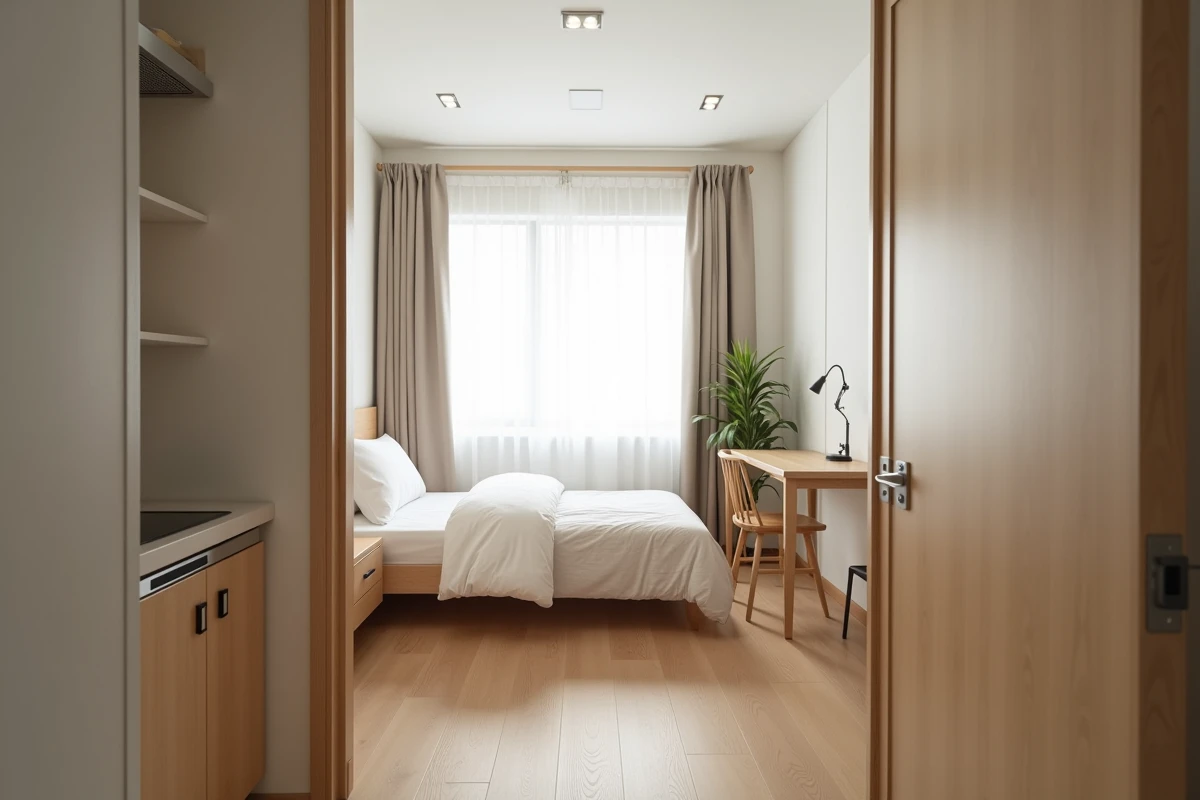
The F1 and the studio are often confused. The difference lies in one element: in an F1, the kitchen is a separate room. The studio integrates the kitchenette directly into the living space.
In practice, a studio offers a single space that serves as a bedroom, living room, and kitchen, with a separate bathroom. The F1 provides a closed main room and an independent kitchen. This distinction may seem slight, but it changes the way of living on a daily basis, particularly regarding cooking smells and furniture arrangement.
Why the distinction matters for a tenant
A studio of equivalent size often appears more spacious visually because the space is not partitioned. The F1, on the other hand, offers more privacy and allows closing the kitchen door. For a student or a young professional, the choice depends on the priority: open volume or functional partitioning.
From F2 to F3: how the number of bedrooms changes the use of the apartment
An F2 has two main rooms. In most cases, this means a living room and a bedroom, with a kitchen and bathroom in addition. This is the classic format for a couple or a single person wishing to separate the sleeping area from the living area.
The F3 adds a room, which generally results in a living room and two bedrooms. This configuration is suitable for a couple with a child, or for a person who uses the additional room as an office. The rent difference between an F2 and an F3 in the same city directly reflects this extra room.
The elements that the apartment type does not reveal
The F1, F2, F3 classification does not provide information about the total area, brightness, or precise layout. Two F3s can have very different sizes. The first may offer three small rooms of 10 m² each, while the second has a large living room of 30 m² and two bedrooms of 12 m². Here’s what the number does not cover:
- The total area of the apartment, which varies widely for the same type of apartment depending on the building and the construction period
- The presence or absence of a balcony, cellar, or parking space, which does not count in the room tally
- The energy performance, which has become a determining criterion since restrictions on energy-inefficient properties

DPE and small surfaces: a recent constraint affecting F1 and F2
Since the Climate and Resilience Law, the type of apartment is no longer sufficient to assess the quality of a dwelling. Apartments rated G in the energy performance diagnosis (DPE) are gradually being excluded from the rental market. Properties rated F will follow.
F1s and F2s are particularly affected by this change. Small surfaces, often located in older buildings, frequently combine poor insulation and unfavorable energy ratings. An F1 rated G can no longer be offered for rent since 2023 if its DPE exceeds a certain consumption threshold.
Before signing a lease or purchase agreement, checking the DPE rating of an apartment has become as useful as knowing its number of rooms. An well-insulated F2 is worth more than an energy-hungry F3 in terms of comfort and monthly expenses.
T or F in real estate ads: should we still care?
The letters T and F refer to exactly the same thing. T comes from “type,” F from “function.” Almost all real estate professionals now use T. F persists in some ads from individuals or in regions where the usage has remained out of habit.
The only thing that really matters is the number. A T3 and an F3 describe an identical dwelling: three main rooms. If you come across a P3 (for “rooms”), it’s still the same thing, although this notation is rare.
The useful reflex when searching for an apartment remains to cross-reference the number of rooms with the living area and the DPE. These three combined data points provide a reliable picture of the dwelling, much more than the single letter displayed in the ad.