Cooking can sometimes feel like a complex equation, especially when recipes call for precise measurements. Converting ounces to milliliters or cups to grams can become a real puzzle, particularly for those juggling international recipes.
Fortunately, mastering the conversion of volume measurements in the kitchen isn’t as difficult as it seems. A few simple tips and conversion tools can greatly simplify the task. With a little practice, transforming the most complicated recipes into a piece of cake becomes possible, and the results in the kitchen are all the better.
Common Cooking Measurement Units and Their Equivalents
In cooking, volume measurements are ubiquitous. They include units such as liter, milliliter, and centiliter. Tablespoons and teaspoons, often used for more precise quantities, are also part of this group. Converting 400 milliliters to liters, for example, involves a simple division to get 0.4 liters.
Volume Conversion Table
| Unit | Equivalent |
|---|---|
| 1 liter (l) | 1000 milliliters (ml) |
| 1 centiliter (cl) | 10 milliliters (ml) |
| 1 tablespoon (tbsp) | 15 milliliters (ml) |
| 1 teaspoon (tsp) | 5 milliliters (ml) |
Weight measurements also play a fundamental role. They come in kilograms, grams, and ounces. Although less common for liquids, they are essential when it comes to dry ingredients like flour or sugar.
Weight Conversion Table
| Unit | Equivalent |
|---|---|
| 1 kilogram (kg) | 1000 grams (g) |
| 1 ounce (oz) | 28.35 grams (g) |
Temperature measurements are essential for cooking. Converting between degrees Celsius and Fahrenheit requires following a simple formula: (°F – 32) x 5/9 = °C. A conversion error can significantly affect the final result of a recipe.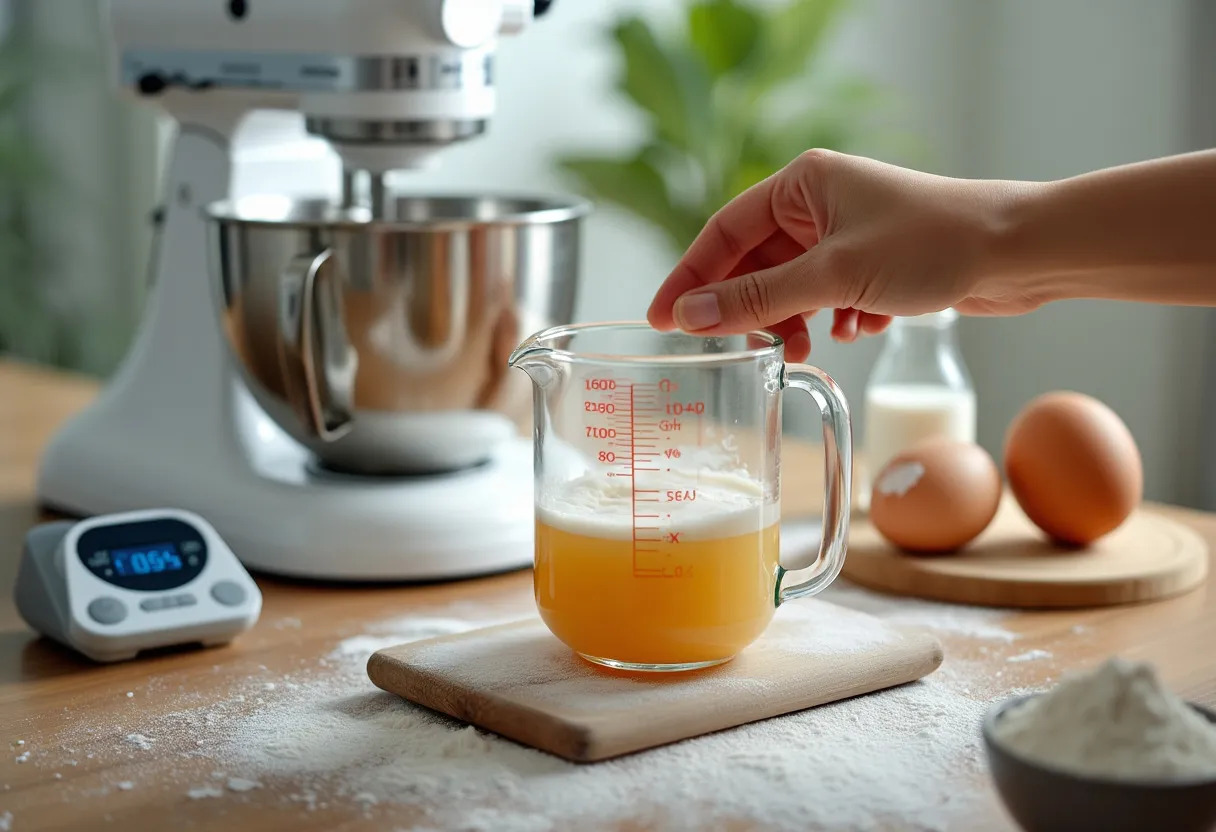
Techniques and Tips for Easily Converting Volume Measurements
Modern cooking has many conversion tools to simplify the lives of cooks. Mobile apps, websites, and cookbooks offer practical solutions for converting volume units. A simple search on www.unefillencuisine.fr can provide you with detailed conversion tables and online calculators.
For those who prefer more traditional methods, measuring utensils and instruments remain valuable allies. Use measuring cups for liquids, kitchen scales for dry ingredients, and measuring spoons for small quantities. These tools ensure precision and consistency in recipes.
Manual conversions are also a skill to master. Here are some useful equivalents:
- 1 liter (l) = 100 cl = 1000 ml
- 1 tablespoon (tbsp) ≈ 15 ml
- 1 teaspoon (tsp) ≈ 5 ml
Approximations can sometimes suffice, especially for ingredients with little variation in density. For example, 1 tablespoon of sugar ≈ 15 g. Be careful of conversion errors that can alter the final result of a recipe. A precise kitchen scale and a reliable kitchen thermometer minimize these risks.