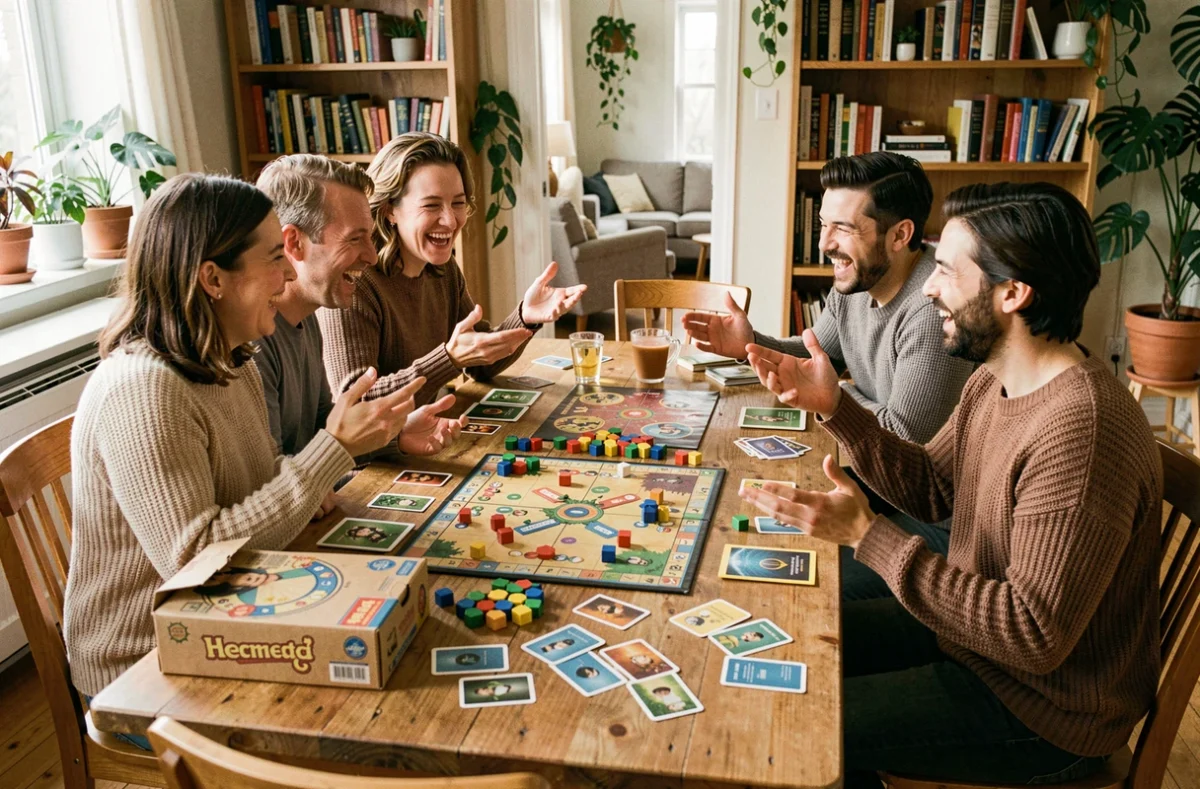
When you open a board game box for the first time in a group, the real difficulty is almost never the strategy. It’s the time spent explaining the rules. If it’s too long, half the table loses interest before the first turn.
The board game industry is experiencing a period of strong growth, driven by an increasingly large adult audience. This expansion is also changing expectations: shorter games, immediate accessibility, formats designed for various contexts.
Short rules and quick games: what the board game market prioritizes today
A report by 20 Minutes published in September 2026 describes the reinvention of classics like Scrabble, belote, or the game of goose around more dynamic mechanics, with less downtime. This trend is not anecdotal. It addresses a concrete constraint: people often play in the evening, between two activities, or at an event where participants do not all know each other.
Immediately accessible games are gaining ground over lengthy rules. Publishers are shortening rulebooks, adding simplified “first game” modes, and focusing on games lasting twenty to thirty minutes. For organizers of playful activities, this has become a priority selection criterion.
This approach can be found in studios specializing in game creation and facilitation, such as on ludika-studio.be, where the short format and accessibility of mechanics guide the choice of games offered at events.

Board games for adults: an audience redefining the offer
The analysis published by Ekonomico in September 2026 links the growth of the French toy market to increased spending per child, but also to the rise of adult consumers and “kidults.” This segment no longer settles for playing the same titles as children.
Adults seek gaming experiences that suit them: more complex themes, immersive storytelling, cooperative modes, or duels. Party games with bluffing or quick deduction mechanics work particularly well in after-work contexts or gatherings with friends.
This evolution has a direct impact on activities. When setting up a table for an adult audience, you cannot offer the same titles as in a children’s game library. The choice of game depends on the number of players, the time available, and the desired level of interaction.
Concrete criteria for selecting a game in an adult animation context
- Game duration of less than thirty minutes, with a rules explanation of under five minutes: this is the threshold beyond which attention drops in a group
- Flexible number of players (at least four to eight) to adapt to tables that fill up during the game
- Mechanics that generate direct interaction between players, not just solo optimization on one’s own board
- Attractive and readable visual material: cards or boards that can be understood at a glance, even in a noisy environment
Board game facilitation: mistakes that ruin a game night
Organizing a game activity is not just about stacking boxes on a table. We have all seen game nights where no one dares to sit down because there is no facilitator to start the first game. The absence of an identified game leader is the primary cause of failure in an activity.
The role of the facilitator is not to know all the rules by heart. It involves identifying the profiles around the table (regular players, novices, hesitant individuals) and guiding each person to the right game. A shy player will not spontaneously join a loud bluffing game. They will feel more comfortable with a calm cooperative game.
Managing the pace during the event
A common mistake is to let a single game last the entire evening. Alternating short formats with a longer game maintains the group’s energy. You start with a quick party game to break the ice, then offer a title with more strategic depth for those who engage.
Feedback varies on this point, but generally, three to four different games for a three-hour evening help maintain a good pace without exhausting the participants’ attention.

New board games: spotting trends without following every release
The volume of new releases each year makes comprehensive tracking impossible. For an individual as well as for a professional facilitator, the question is not to know everything but to filter releases based on real usage criteria.
Game fairs and festivals remain the best way to test before buying. You discover prototypes, interact with publishers, and most importantly, you can observe the reactions of players discovering a title for the first time. This real-world observation is worth more than any product sheet.
On the trend front, cooperative games continue to grow. Legacy mechanics (where the game evolves from one session to the next) attract a loyal audience. And modernized reissues of classics, with simplified rules and updated materials, capture an audience that wants to revisit familiar titles without the burdens of the past.
- Cooperative games are suitable for mixed groups where competition can create tensions
- Legacy formats retain players over multiple sessions, which works well in clubs or associations
- Reissues of classics allow reaching nostalgic players while offering a modernized experience
The French toy market shows strong dynamics, but board games and puzzles may experience occasional declines in an overall rising context. Focusing on the quality of the experience offered rather than the quantity of references remains the most reliable strategy, whether organizing a night with friends or an event for fifty people.